The short answer
- Procurement software should hold one record per purchased line and move it through stages that each answer one question — from what the customer bought to what actually came off the lorry.
- The scale is what breaks the spreadsheet. One recent load carried 39 customer orders and 56 plant lines; loads arrive roughly weekly; 78 orders are live at once, about 150 in the busy season.
- Costed against those volumes, the old method consumed 700–920 hours a year — 14 to 19 hours every week, rising to about 26 hours a week in the busy season, or £10,500–£18,500 a year in clerical time.
- The bigger cost was invisible: every extra grower asked meant another email assembled by hand, so buying was rationed to three growers a line. One press now reaches the whole database of 100+ growers at the same cost.
- A comparable build costs £80,000–£200,000+ from a UK agency over 4–9 months. This one started from £12,000 and is buying real stock.
Procurement software earns its place when it owns the whole journey of a single line. One plant, at one specification, on one customer's order — moving through New, To source, Quoting, Award, Ordering, Lorries, Goods in and Archive. Every screen is a waiting room: a line sits in one until the job that room exists for has been done, and then it moves on. Every move is dated and named, and nothing is ever quietly lost.
What was actually wrong with a buying spreadsheet?
A workbook and an inbox were holding a six-figure buying operation together with copy-and-paste:
- The workbook only knew what somebody remembered to type. It could tell you where a line was if the last person to touch it had written it down, and not otherwise.
- Enquiries were assembled by hand. Lines copied into an email, one email per grower, sent out and then forgotten about until somebody replied.
- Prices came back as prose. Replies were read and retyped into the sheet before anything could be compared — and the comparison is the entire point of asking more than one supplier.
- Confirmations were pasted back in. Purchase orders were written by hand, chased from memory, and marked confirmed by whoever happened to read the reply.
- Nothing tracked inbound stock. No record of what was on the water, what landed, what was damaged or what was owed back — so claims were made when somebody remembered to make them.
The costs were structural rather than clerical: money left on the table for want of a real comparison, buying mistakes when a specification drifted between the sale and the enquiry, damaged stock that quietly became a write-off instead of a claim, and no history worth the name — so nobody could say what a line usually costs, or which supplier is actually good to deal with.
How do suppliers quote without an inbox in the middle?
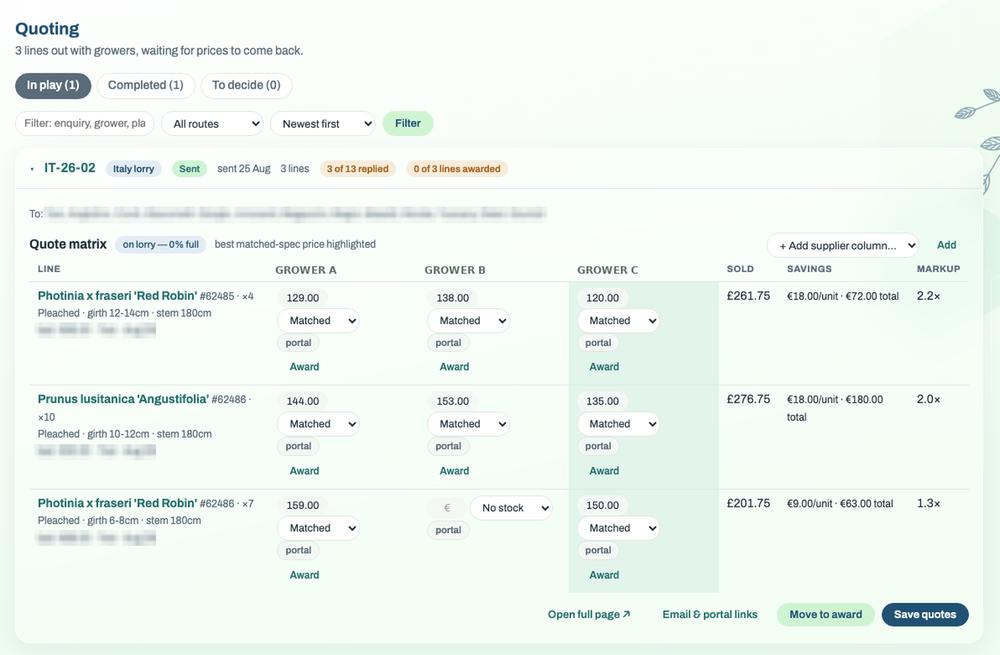
A buyer tags each line with the country they mean to ask, and it joins that country's list. The list keeps collecting, day after day, because a supplier prices a full sheet far faster than they answer a trickle of one or two. Nothing reaches anybody until the list is sent — and that one press emails every supplier on the route their own pricing page, builds the comparison matrix and moves the lines on.
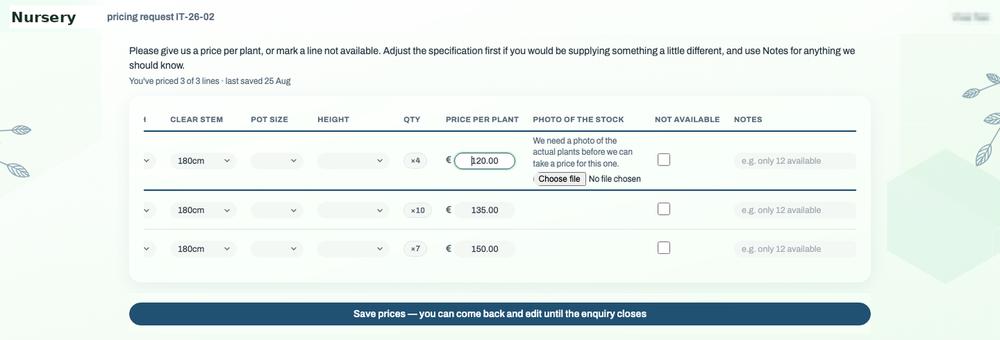
Each supplier gets an unguessable link of their own. Their prices land straight in the matrix, labelled as having come from them rather than from the office, and the buyer's bell rings. A supplier who telephones instead has their whole column typed in on one screen. Nothing is transcribed twice, and a blind save can never overwrite a supplier's own answer.
Buy-it-unseen protection
A line can be marked photo required when it is expensive or awkward. The enquiry then says so in as many words, the supplier's page grows a photo box for that row alone — on a phone it opens the camera, so they can walk out into their own nursery and take it — and their price for that line will not save without one. Every other price on the same sheet saves as normal.
What happens when you award a supplier?
More than recording a winner. Pressing Award in a cell files the line onto a draft purchase order for that supplier, saves the price and currency exactly as they stand today, and puts the order onto the right lorry. A run of awards stays fully correctable until the batch is deliberately released — and then each order is sent, chased and confirmed from one screen. A supplier confirms by clicking a link in the order email, and confirmed lines move themselves.
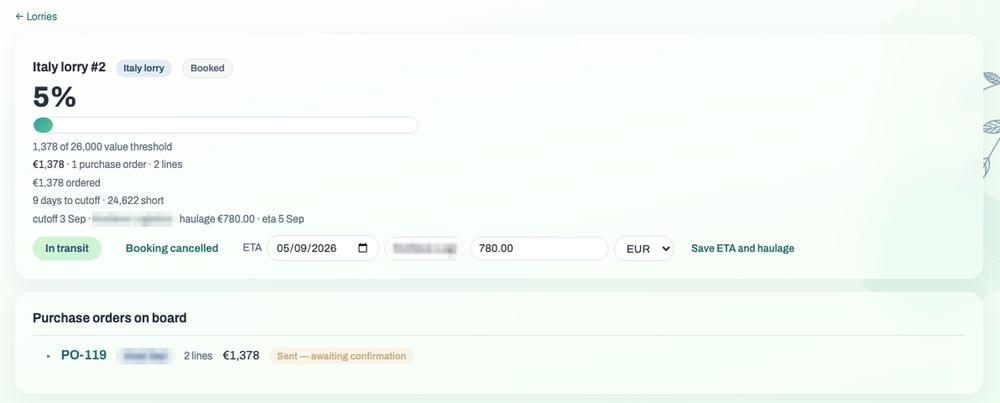
Every purchase order rides a lorry, and a lorry fills as awards are made until it reaches the route's value threshold or its cutoff date passes. The board turns amber inside the warning window and stops taking orders the day after cutoff, at which point the next award simply opens a fresh order on the current lorry. Haulage is recorded in the currency the haulier invoices in and never mixed into the value of the stock on board — because the business buys in euros and sells in pounds, and a made-up exchange rate would hide a real number.
How do you know what actually arrived?
Somebody walks the lorry with a phone. This screen is not the ordinary application made smaller: it is built for a phone held sideways in two hands, outdoors, in gloves, with a lorry waiting. The whole right-hand edge is pass, the whole left-hand edge is fail — opposite sides on purpose, so a fumbled reach cannot turn one into the other — and the middle is for reading and cannot be pressed.
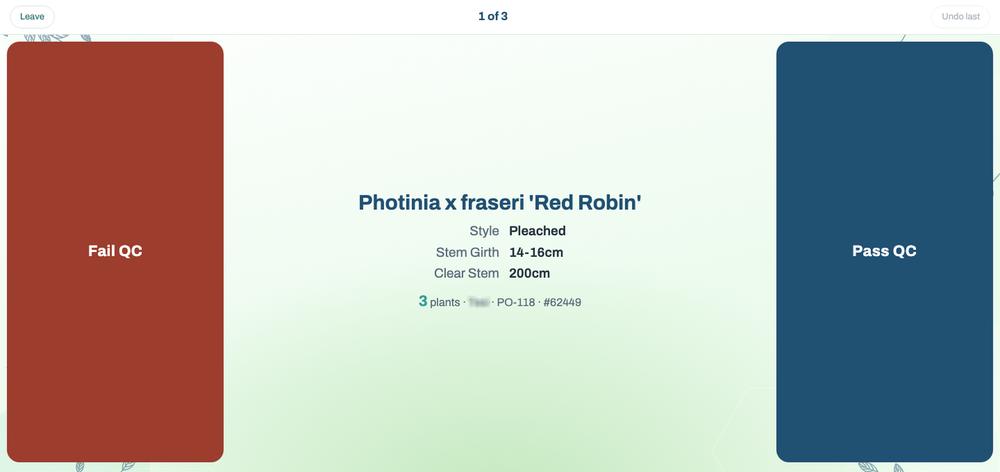
A fail does the whole job in one press: it records the verdict and the photograph, raises the delivery issue against the supplier, and moves the customer's deal to quality review in the sales system so the customer is told the right thing. Each line saves on its own press, so a lost signal in the yard costs one line, never the whole walk.
This is the part that was never possible before. Damaged stock used to become a write-off because nobody had the evidence, or the time, to turn it into a claim. Now every fault is raised against the supplier the moment it is found, priced at what was paid, with the photograph taken at the yard gate attached — and the claim letter writes itself from the open issues on that order.
What volume does this actually run at?
This is the part that decides whether any of the above matters, and it is the part most people underestimate. A load is not a handful of trees.
| What the business counts | Figure | Where it comes from |
|---|---|---|
| Customer orders on one recent load | 39 | Actual, most recent Italy lorry |
| Separate plant lines on that same load | 56 | Actual, same lorry |
| Loads a year | ≈ 50 | Roughly weekly, steady year-round |
| Orders live in the pipeline right now | 78 | Counted off the procurement board |
| Orders live in the busy season | ≈ 150 | Stated by the business |
| Plant lines bought a year | ≈ 2,800 | 56 × 50 loads |
| Customer orders a year | ≈ 1,950 | 39 × 50 loads |
And then the season arrives
Every figure above is an annual average, which is the kindest possible way to describe this job. Live orders roughly double in the busy season — 78 becomes about 150 — on the same office staff. Scaling the week by that ratio:
| In one week | Quiet | Peak |
|---|---|---|
| Orders live in the pipeline | 78 | ≈ 150 |
| Plant lines moving through | ≈ 56 | ≈ 108 |
| Customer orders landing | ≈ 39 | ≈ 75 |
| Office hours the old method consumed | ≈ 14 hrs | ≈ 26 hrs |
| As a share of one full-time person | ≈ 36% | ≈ 70% |
Across roughly twelve peak weeks that is about 313 hours — £4,700 to £6,300 of office time compressed into the window where the business can least spare it. Peak is when stock is scarce, customers are waiting and every hour on the phone is worth more than an hour anywhere else; it is also the point at which the manual method was consuming two-thirds of a person doing nothing but copying and retyping.
What did it actually save?
Four jobs in the old method had to be done per plant line, not per order: copying the line into an enquiry, retyping the price that came back, raising and confirming the purchase order, and checking what arrived. At 2,800 lines a year that is where the hours go. Costed against the volumes above:
| Old-method task | Volume a year | Rate | Hours a year |
|---|---|---|---|
| Reading the shop and typing each line into the workbook | 2,800 lines | 2 min | ≈ 93 |
| Copying each line into an enquiry email, once per supplier asked | 8,400 line-copies | 1½ min | ≈ 210 |
| Reading replies and retyping prices so they could be compared | ≈ 5,900 prices | 1½ min | ≈ 147 |
| Raising and confirming purchase orders | 2,800 lines | 2 min | ≈ 93 |
| Chasing purchase orders | ≈ 400 orders | 10 min | ≈ 67 |
| Tracking what was on the water | 50 loads | 1¼ hrs | ≈ 62 |
| Answering “where is my order?” | ≈ 650 calls | 12 min | ≈ 129 |
| Total, at three suppliers asked per line | ≈ 800 hours |
Ask two suppliers a line instead of three and it is about 680 hours; ask four and it is about 920. So the honest range is roughly 700 to 920 hours a year — 14 to 19 hours every working week — and at a loaded admin cost of £15–£20 an hour, £10,500 to £18,500 a year in clerical time alone, before a single buying decision is improved.
The load volumes, the load frequency and the live-order counts are the business's own figures, read off its own system. The minute rates, the two-to-four suppliers asked per line, the 70 per cent supplier reply rate, the eight purchase orders a load and the third of customers who ring for an update are stated assumptions — replace them with your own and the hours move with them. The arithmetic is shown so they can be.
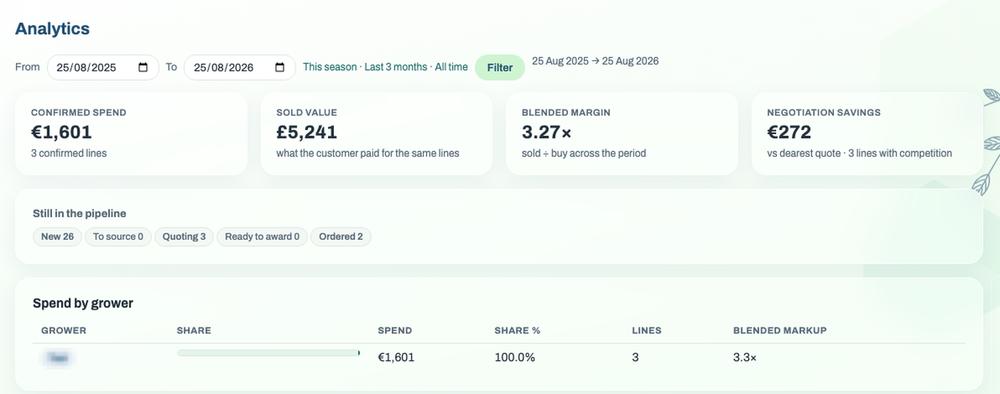
The bigger returns are not on that table. Negotiation became visible: where two or more suppliers priced the same line, the difference between the dearest offer and the one taken is counted and reported — a number that did not exist before, and the direct return on asking more suppliers. Buying errors fell, because the specification the supplier is asked for is the specification the customer bought, carried automatically, with any doubtful line flagged all the way to the person choosing. And history became worth having: three years of buying, the old workbook imported alongside the live work, searchable by line, supplier, month or lorry, plus a record of how each supplier actually behaves — reply rate, win rate, outstanding orders, fault rate.
Why did they only ever ask three growers?
Because every extra grower asked cost about a hundred and twenty hours a year, and they knew it.
This is the part of the old method that never showed up as a line on anyone's timesheet, and it is the expensive part. Every additional grower you want a price from is another email to assemble by hand from the same 56 lines, and another set of replies to read and retype. So the buying team asked two to four growers, ten at the absolute outside — not because that was the right number, but because it was the number the working day could carry.
| Growers asked per line | Office hours a year, old method | What that is |
|---|---|---|
| 2 | ≈ 680 | 14 hrs a week |
| 3 — the working normal | ≈ 800 | 17 hrs a week |
| 4 | ≈ 920 | 19 hrs a week |
| 10 — the absolute outside | ≈ 1,640 | 34 hrs a week — a full-time person |
| 100+ — the whole database | ≈ 12,300 | 7½ full-time people. Not a decision, an impossibility. |
One press now reaches the entire supplier database — more than a hundred growers — at the same cost as reaching three, because the software writes every pricing page and collects every answer into the same matrix. That is 280,000 line-quotes a year of reach, against roughly 8,400 before, and the office spends no longer on it either way.
That is where this stops being an admin story. A grower who was never asked cannot undercut the one who was, so every line quoted against three suppliers instead of a hundred carried an invisible margin cost that nobody could see, price or argue with. It is also why the system counts the difference between the dearest offer and the one taken and reports it: the negotiation saving is the direct return on being able to ask everybody, and until the enquiry became free it was not a number anyone could have produced.
And it compounds at exactly the wrong moment. In the busy season, when stock is short and a grower may simply not have what you need, the difference between asking four and asking a hundred is not a better price — it is whether the order can be filled at all.
What does procurement software cost to build?
This is a substantial multi-integration platform: e-commerce sync, a CRM integration with write-back, password-free supplier portals with photo capture, a multi-currency quoting and awarding engine, purchase-order and claim correspondence, container consolidation, a mobile quality-control screen and an analytics warehouse over imported history. Indicative UK market rates for that scope in 2026:
| Approach | Typical cost | Timeline | Notes |
|---|---|---|---|
| UK software agency | £80,000 – £200,000+ | 4–9 months | Discovery workshops, sprint teams, project-management overhead |
| Established freelance developer | £30,000 – £70,000 | 3–6 months | Single developer at £350–£600/day across 60–140+ days |
| Off-the-shelf procurement SaaS | £3,000 – £15,000 / year | Ongoing | Per-seat pricing built for parts and stock codes, not living stock. No supplier quote portals, no lorry consolidation, no yard walk, no name learning — and the workbook survives alongside it. |
| This build | From £12,000 | Days, not months | Delivered feature by feature against the buyer's real working day; live in production and buying real stock |
Ranges are indicative UK market figures for comparable scope and should be validated against current quotes. The point stands anywhere inside them: the traditional routes cost tens of thousands of pounds and half a year of elapsed time — and the off-the-shelf route never actually fits a business that buys living stock by the lorry-load.
How was it delivered?
- Built against real pains, not a spec document. The stages are the ones the office already worked in; the route colours are theirs; the quality-control remedies are fetched live from their own sales board, so adding one there adds it here.
- Written to be learned in a morning. The application explains itself — screen introductions and help markers each person turns on or off for themselves — and it ships with an operator's manual written in the same plain words the buttons use.
- Honest about money. Nothing is converted between currencies anywhere. A total spanning euros and pounds prints as both, because a made-up exchange rate hides a real number.
- Careful with other people's data. Supplier pages are password-free but tokenised, read-only once the enquiry closes, and revoked with the supplier; photographs are served only to people with business with them, with camera metadata stripped.
- Iterated in conversation. Improvements ship the same day they are raised, through an in-app board the team uses to ask for changes.
Does this only work for importers?
No. The shape generalises to any business that asks several suppliers for a price, picks one, raises an order against it and then has to know what arrived — builders' merchants, food and drink, manufacturing components, hire fleets, anything bought to order rather than off a shelf. If your buying currently lives in a spreadsheet and an inbox, the same pipeline exists in your business; it is just not written down anywhere.
It usually starts with an operations audit: a walk through the buying week, a map of every retyping step between your tools, and a costed list of what could be collapsed. Three more builds are written up in full — delivery route planning software, fencing quoting software and wholesale order management — and the short version of the method sits on the byHoratio homepage.
Questions people ask about procurement software
What should procurement software actually do?
It should carry one record per purchased line from the customer's order to the yard gate, through stages that each answer exactly one question: what did the customer buy, who should we ask, what did they quote, who wins it, has the order been confirmed, what is it travelling on, and what actually arrived. If any of those answers still lives in an inbox or a spreadsheet column, the system is a filing cabinet rather than a pipeline.
At what volume does buying on a spreadsheet stop working?
Sooner than most firms admit, because the load is what breaks it rather than the year. One recent load into this business carried 39 customer orders and 56 separate plant lines, loads arrive roughly weekly, and 78 orders sit live in the pipeline at any moment — about 150 in the busy season, when the same office staff carry roughly 26 hours a week of clerical buying instead of 14. A workbook can hold that many rows; what it cannot do is tell you where each of 78 orders has got to unless the last person to touch it remembered to write it down.
How many suppliers should you get quotes from?
As many as you have, which is only possible once the enquiry costs the same whether it goes to three or a hundred. Under the manual method this business asked two to four growers a line and ten at the absolute outside, because every extra grower meant another email assembled by hand from the same 56 lines — asking ten a line works out at about 1,640 office hours a year and asking the whole database about 12,300, which is seven and a half full-time people rather than a decision. One press now reaches all 100-plus growers, and the difference between the dearest offer and the one taken is counted and reported as the negotiation saving.
How do you compare supplier quotes without retyping emails?
Give each supplier their own unguessable link to a page showing only their own lines. They enter a price per line, mark anything unavailable, adjust the specification if they would supply something slightly different, and add a note. Their answers land straight in the comparison matrix labelled as having come from them rather than from the office — and a blind save can never overwrite a supplier's own answer. A supplier who telephones instead has their whole column typed in on one screen.
What does procurement software cost to build?
For a substantial multi-integration platform — e-commerce sync, CRM integration with write-back, password-free supplier portals with photo capture, a multi-currency quoting and awarding engine, purchase-order and claim correspondence, container consolidation, a mobile quality-control screen and an analytics warehouse over imported history — UK market rates in 2026 run £80,000–£200,000+ from an agency over four to nine months, or £30,000–£70,000 from an established freelance developer over three to six months. This build started from £12,000.
Is off-the-shelf procurement SaaS good enough?
It depends on what you buy. Per-seat procurement SaaS at £3,000–£15,000 a year is built for parts and stock codes with stable specifications. It has no supplier quote portals, no container consolidation, no goods-in walk and no way to learn that two spellings of a plant name mean the same plant — so for a business buying living stock by the lorry-load the workbook survives alongside the subscription, which is the worst of both.