The short answer
- Fencing quoting software should turn one on-site measurement into a price, a customer quotation and an installer drawing — with nobody redrawing or repricing the job at a desk afterwards.
- In this build the surveyor draws the fence on a tablet while measuring it, so the one to two hours of drawing per job became zero, and the ten minutes of calculator work in the van became instant.
- At the firm's real volume of 14–15 surveys a week that is 16–32 hours returned every week — roughly £13,000–£26,000 a year at a £17/hour loaded surveyor cost.
- The pricing knowledge moved into software: 57 catalogue items and 29 rules seeded from the firm's own spreadsheet, with 3,341 automated tests standing behind the money maths.
- A comparable build costs £50,000–£120,000+ from a UK agency over 3–6 months. This one started from £8,000 and was live in production 11 days after the first commit.
Fencing quoting software earns its place when the quote is produced during the site visit, not after it. The surveyor draws the fence line while measuring; the software derives the bill of materials from that drawing against the firm's own price book and prices it on the spot. One survey, one set of numbers, three documents — and no expert required at the desk afterwards.
What was actually wrong with quoting on paper?
Nothing that any fencing firm would call broken. It worked — it just cost a fortune in skilled hours and it capped the size the business could reach. The old chain ran like this, and most contractors still run it:
- The booking was recorded three times. A customer rang, the details went onto paper, the surveyor typed the visit into his own calendar, and someone kept a separate record. Three versions of one appointment, none of them definitive, and no way to see which days were already full.
- The survey was a paper sheet. Lengths, heights, gate positions and site conditions written by hand, to be deciphered later by whoever drew and priced the job.
- The price was ten minutes in the van with a calculator. Bays, posts, gravel boards, concrete and labour worked out under time pressure with the customer at the window, then carried back up the drive as a number nobody had a chance to check.
- The rates came from memory, or a printed list. Whether a job was priced correctly depended on which surveyor took it and whether the list in their van was current. A price rise only reached the customer when it reached every surveyor's memory.
- The drawing took one to two hours, later. The same paper sheet redrawn at a desk into something the customer and the crew could both read — the single most expensive piece of admin in the process, repeated on every job.
- Nothing was visible. No pipeline, no conversion rate, no record of what was quoted last month or why a job was lost.
The real constraint sits underneath all of it. Quoting a fence required an experienced fencing person — someone who knew the products, the build details and the prices well enough to hold them in their head in a customer's garden. That makes every surveyor a slow, expensive, scarce hire, and it puts a hard ceiling on growth.
How does the price come out of the drawing?
The surveyor taps out the fence line on a touch canvas as they walk it — straight runs, corners, curves, stepped ground — optionally calibrated over satellite imagery so the shape matches the real garden. Gates are placed on the run they belong to and sized through a checker that knows the firm's own gate formula. One measurement sets the scale for the whole drawing: the accuracy comes from the tape, not from the tapping.
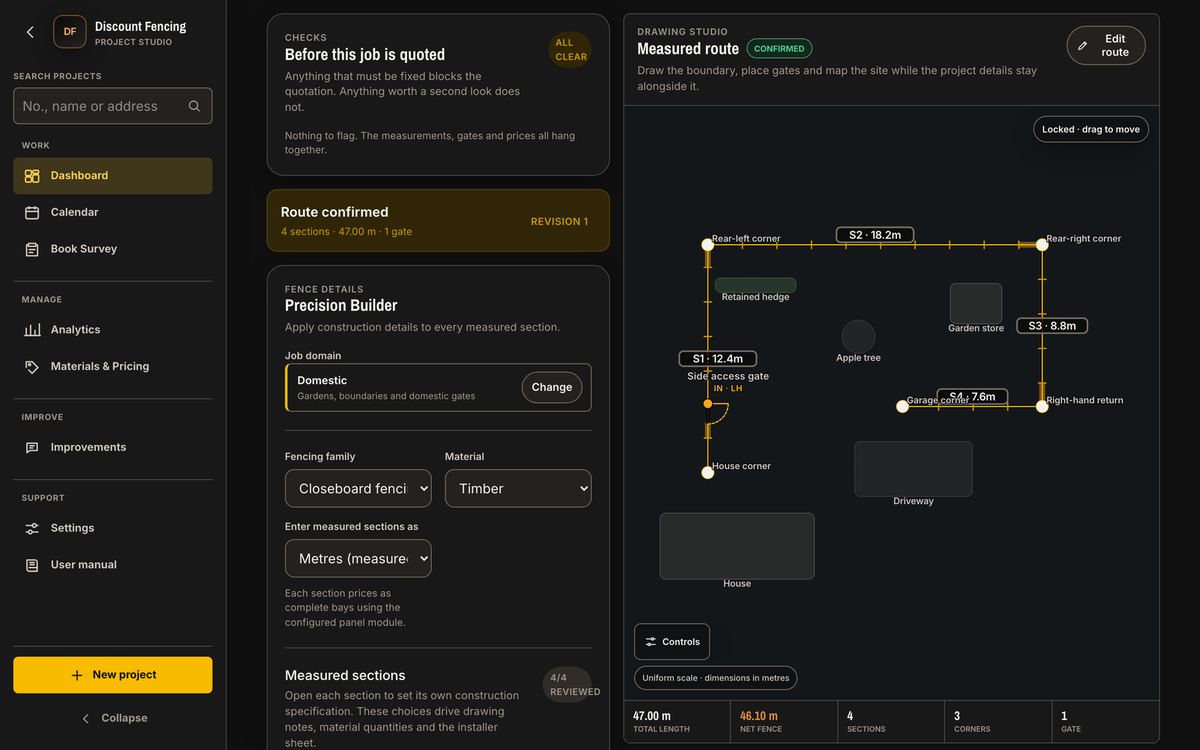
The pricing engine then turns that measured route into a bill of materials using the firm's own price book — 57 catalogue items and 29 rules, seeded directly from their existing spreadsheet. Panels, posts by type, gravel boards, feather-edge, concrete, ballast, fixings, labour, waste allowance and gates are all derived from the geometry rather than typed in. Repairs and re-clads are priced as their own kinds of work.
Every decision an experienced estimator used to make — which questions to ask, how the materials fall out of the measurements, what the rates are — is now a rule in the software. The quality of the quotation stops depending on which surveyor turned up.
And it can be negotiated at the door
At the end of the walk-round the surveyor reaches a one-hand summary on the phone: the cost of each run, the shared job costs, the total, and the two decisions that close the sale — how the customer intends to pay, and on what terms. Quantities, unit rates, added or removed materials, labour and the final agreed price are all adjustable there, every figure recomputed by the same engine that produced the quote. A customer asking for a keener price gets a real number at the door, not a promise to ring back.
What documents does one survey produce?
Three, generated from the same measured survey and the same priced take-off, so they cannot contradict one another. Each is A4, print-ready, and paginates intelligently — a short job fits one sheet, a long one flows without splitting a card or a table row across the fold.
- The customer quotation — the firm's brand sheet, with the payment schedule broken out stage by stage, the fence summarised at a glance, and the terms the customer signs against.
- The professional drawing — the plan the customer and the crew both read, already produced, because it is the survey.
- The installer job card — deliberately unlike the quotation: high-contrast, ticked as the work is done, with the pick list grouped the way the van is loaded and metric and imperial side by side. It carries no customer prices; the crew needs the specification, not the commercial terms.

Every issued quotation is frozen rather than overwritten. A reprint months later shows exactly what that customer agreed to, even after the price book has moved on — and if prices change underneath a live quote, the office is warned rather than silently re-quoting.
What does the rest of the business get?
Survey bookings show which days already hold visits, in 30-minute slots across the working day, with the address filled in from a postcode lookup. Installations are booked to crews across multiple days, moved with a confirmation, and exported to the calendar the crews already read. The booking is captured once, on the call, and that record is the definitive one.
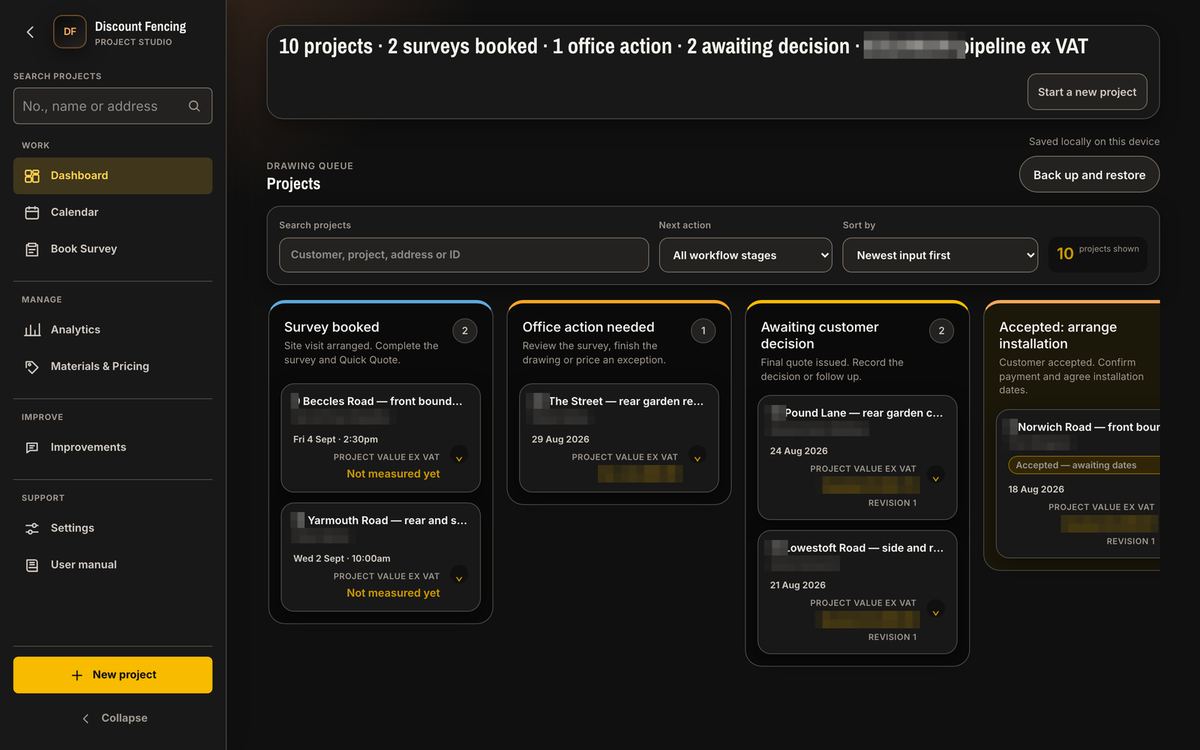
Above it sits the layer the owner had never had: pipeline by stage, issued quote value, conversion, average sold job and current workload, with declined jobs recorded against a reason and excluded from the pipeline. Underneath it sits one price book, organised by fencing family, with cost, sale price and margin per item. A supplier increase is entered once and applies to every quote from that moment — while quotations already issued keep the figures the customer agreed to.
What did it actually save?
Based on the firm's own account of the workflow this replaced — a paper survey sheet, roughly ten minutes of calculator work in the van, and one to two hours producing the drawing afterwards — against their actual diary of 14–15 surveys a week.
| Task | Before | After | Time returned |
|---|---|---|---|
| Producing the drawing | 1–2 hours per job, at a desk | Drawn while measuring | 14–30 hrs/week |
| Working out the price | ~10 min per job with a calculator | Instant, from the drawing | ≈ 2.5 hrs/week |
| Re-pricing a change | Start the sums again | Seconds, recalculated live | Every negotiation |
| Briefing the crew | Hand over the drawing and explain | Printed job card from the same survey | Fewer wasted trips |
The saving that changes the business, though, is not on that table. The workforce becomes scalable. Surveying is now a job for anyone who can measure accurately and talk to a customer, so the firm recruits from the whole labour market instead of the narrow pool of experienced fencing estimators, and trains in an afternoon rather than over seasons. Growth stops being capped by how many experts the business can find, keep and afford.
What does fencing quoting software cost to build?
This is a genuine trade platform: a geometry and drawing engine, a rules-driven pricing engine over a real price book, three print-quality document generators, a scheduling diary, multi-device sync with photo storage, and an analytics layer. Indicative UK market rates for that scope in 2026:
| Approach | Typical cost | Timeline | Notes |
|---|---|---|---|
| UK software agency | £50,000 – £120,000+ | 3–6 months | Discovery workshops, sprint teams, project-management overhead |
| Established freelance developer | £18,000 – £40,000 | 2–4 months | Single developer at £350–£600/day across 40–80+ days |
| Off-the-shelf field-service SaaS | £1,200 – £5,000 / year | Ongoing | Per-user pricing; generic fit — no fence take-off, no drawing engine, no gate formula, no job card. The spreadsheet survives alongside it. |
| This build | From £8,000 | Days, not months | Delivered feature by feature against the firm's real working day; live in production and carrying real jobs |
Ranges are indicative UK market figures for comparable scope and should be validated against current quotes. The point stands anywhere inside them: the traditional routes cost tens of thousands of pounds and a quarter to half a year of elapsed time — and the off-the-shelf route never actually knows what a gravel board is.
How was it live in eleven days?
- Built against a real trade, not a specification document. The price book came from the firm's own spreadsheet. The gate pricing follows their formula. The panel and gravel-board vocabulary is the one their surveyors already speak.
- Field-tested and corrected in the open. The software was walked end to end against realistic jobs repeatedly during the build; every issue found — from unreadable text in sunlight to a quotation that disagreed with its own rows — was fixed and pinned with a test so it cannot come back.
- Production from the start. Cloud-hosted with a custom domain, secure login, a database and persistent photo storage; the firm's surveyors have used it on real customer visits.
- Iterated in conversation. Changes raised in the morning ship the same day — the payment terms, the job card design and the drawing notches all began as a sentence from the owner.
- Deliberately durable. 3,341 automated tests, roughly 84,000 lines of typed code, and a hard rule that the quoting maths lives in plain tested modules rather than in the screens.
- Phase one, not the finished article. The survey-to-quote-to-drawing chain was attacked first because it was the most time-consuming activity in the business. Sprints continue: expanded material offerings, further modules, and a full ERP built from the same foundation.
Does this only work for fencing?
No. The question worth asking is not “how much admin could we save?” — it is who in your business is allowed to quote a job, and what happens to your growth when you cannot hire another one of them.
Most trades have the same bottleneck. The person who can price the work is experienced, expensive and scarce, and everything queues behind them. Move the decisions they make into software and the constraint disappears: the work can be done by anyone you can train to measure properly, while the quality of every quotation stays as good as your best estimator made it. The pattern generalises to landscaping, decking, driveways, roofing, guttering, flooring, glazing and groundworks — any trade that measures something on site, derives materials from those measurements, prices them from a book and hands the customer a document.
That is what the operations audit is for: two days inside the working week, finding where the hours actually go and what a system would have to decide before anyone writes a line of code. Three more builds are written up in full — delivery route planning software, procurement software and wholesale order management — and the shorter version of the whole method sits on the byHoratio homepage.
Questions people ask about fencing quoting software
How long should it take to quote a fence?
With the survey, pricing and drawing in one system, a quote is produced during the site visit itself — the surveyor draws the fence while measuring and the price comes out of that drawing. In this build the ten minutes of calculator work in the van became instant, and the one to two hours of drawing afterwards disappeared entirely because the drawing is the survey.
Do surveyors need estimating experience to use fencing quoting software?
No — and removing that requirement is the point. The pricing knowledge lives in the software: 57 catalogue items and 29 rules seeded from the firm's own price book, with the bill of materials derived from the drawing rather than typed in. A surveyor needs to measure accurately and talk to a customer, so the firm can hire from a far wider pool and train in an afternoon rather than over seasons.
Can it produce a drawing the customer and the installation crew can both use?
Three documents are generated from the same measured survey and the same priced take-off, so they cannot contradict one another: a customer quotation on the firm's brand sheet, a professional fence plan drawing, and a hi-vis installer job card carrying the section schedule, the pick list and no customer prices.
What does fencing quoting software cost to build?
For a build of this scope — a geometry and drawing engine, a rules-driven pricing engine, three print-quality document generators, a scheduling diary and an analytics layer — UK market rates in 2026 run £50,000–£120,000+ from an agency over three to six months, or £18,000–£40,000 from an established freelance developer over two to four months. This build started from £8,000 and was live in production 11 days after the first commit.
Will it work with our existing price list?
It should start from it. In this build the price book was seeded directly from the contractor's own spreadsheet — 57 items and 29 rules — and the gate pricing follows their existing formula. A supplier increase is entered once and applies to every quote from that moment, while quotations already issued keep the figures the customer agreed to.
Is off-the-shelf field-service software good enough?
For scheduling and invoicing, often yes. For quoting a fence, generally not: per-user field-service SaaS at £1,200–£5,000 a year has no fence take-off, no drawing engine, no gate size formula and no installer job card, so the spreadsheet survives alongside it. The honest test is whether the tool knows what a gravel board is.